
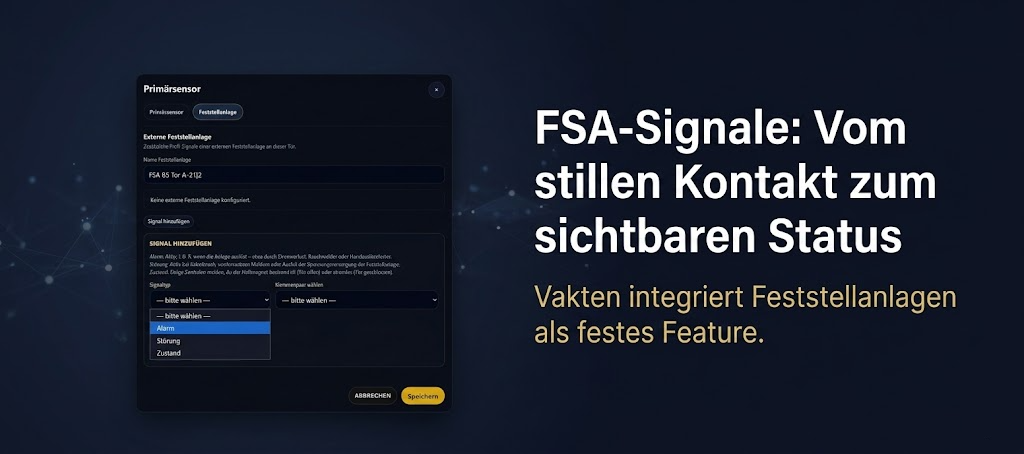
Many signals are already present in facilities. The actual problem is often not the contact itself, but the fact that its state is hardly visible in daily life, only locally accessible or readable only with specialist knowledge.
This is exactly where the new FSA feature comes in.
Potential-free contacts can now be connected in the professional terminal area and evaluated digitally in Vakten. This turns a silent signal into understandable information within the system. States can be made visible, classified and embedded into the overall view of the facility.
The professional distinction is important here: Vakten observes and evaluates. The safety logic itself is neither replaced nor distorted. This is not about intervention, but about clarity.
A typical use case
Think of a hospital with many hundreds of doors and hold-open systems organised in a decentralised manner. In such structures, a fault or activation often remains local. Even if signals are fundamentally available, they often do not reach the place where someone can evaluate them meaningfully.
And this is not an exception, but rather the rule: a large share of hold-open systems used across Europe operate as decentralised islands. Not because the system itself cannot provide signals, but because there is a lack of a simple and practical receiver.
This is where Vakten listens to the FSA.
If an alarm is present, a fault occurs or a relevant state changes, Vakten can capture the event digitally, make it visible and inform the operator in a targeted way – for example by email. A local contact thus becomes a traceable, system-readable state.
For operators, that means more overview, less blind flight and a much calmer way of handling large, distributed inventories.
For manufacturers and technical partners, it means that existing contacts and signals can be translated into an understandable digital layer with manageable effort.
This feature makes very clear what SVARTLIND stands for: not additional complexity, but readable states in real operation.