

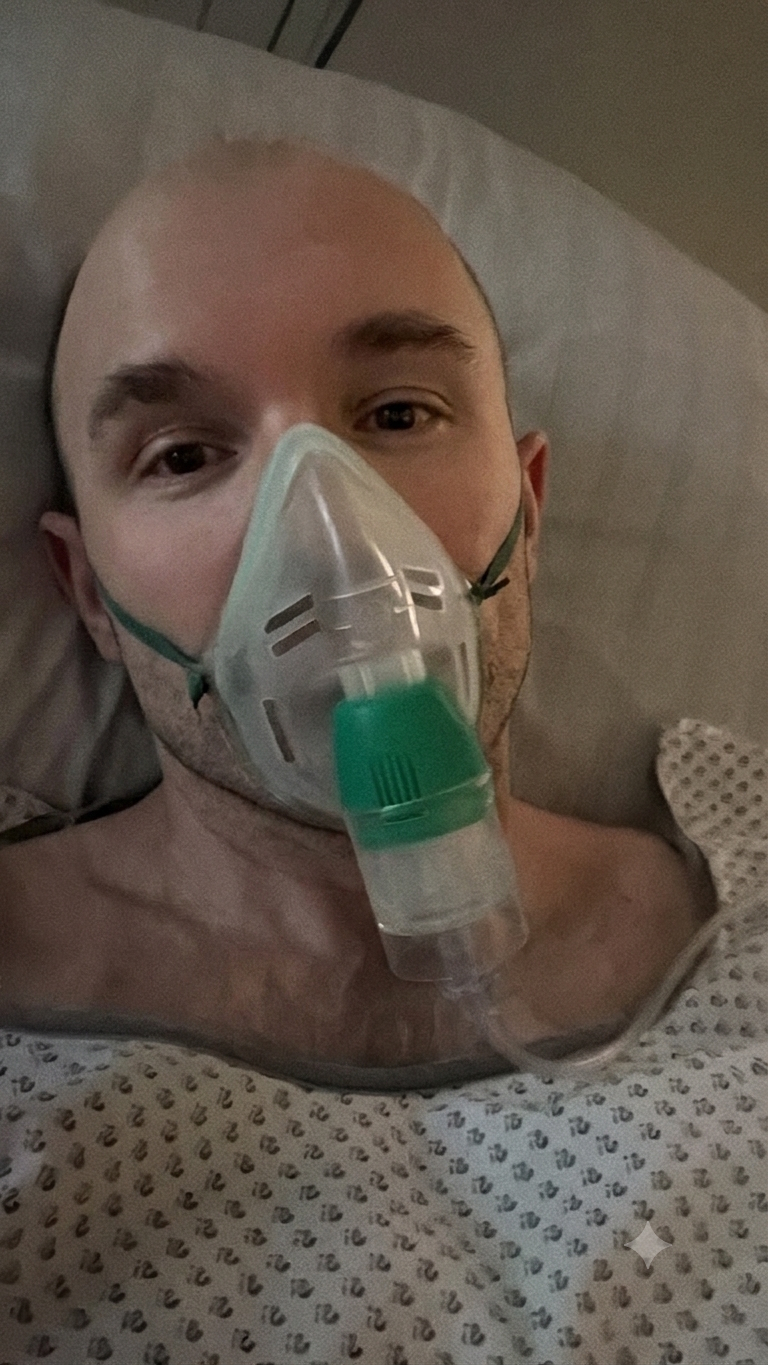
I was transporting a 24.9 per cent ammonia solution in a tank. UN 2672, a Class 8 dangerous good. During unloading, gas was released. There was no warning before I could no longer breathe.
Nine days later, my eyes were still burning and my senses of smell and taste remained impaired.
When the idea for VAKTEN and HJÄRTA first emerged, one question was at its core: How can conditions be made visible earlier, before a person has to realise with their own body that something is wrong?
HJÄRTA and VAKTEN grew from this way of thinking. HJÄRTA captures technical states and measurements. VAKTEN turns them into understandable information.
To keep the development moving independently, I worked for a time as a truck driver in ADR dangerous-goods transport. It was there that an abstract technical question suddenly became very personal.
What happened?
During unloading, a technical fault occurred and gas was released. I had no influence over it, and any other driver could have found themselves in the same situation.
There was no warning.
Suddenly I could no longer breathe properly. It did not take long to put on my protective mask and activate the filter. But it still took too long.
I was subsequently treated in hospital for several days following ammonia gas exposure.
A person should not be the sensor
In fire protection, one simple principle has guided me for years: the highest protection objective is the protection of human life.
After the accident, this led me to ask questions.
Why are truck cabs not considered more consistently as defined protective spaces during the loading and unloading of dangerous substances? Why is suitable gas detection not a natural part of the protection concept wherever hazardous gases or vapours may be released?
Technically, such solutions are fundamentally possible. The decisive question is not whether every conceivable hazard can be eliminated. It is whether a person can be warned earlier.
What could have warned me earlier?
HJÄRTA itself is not a gas sensor and is not an approved gas warning system.
But the technical principle behind it is exactly what interests me in this question: a suitable sensor detects a state or measurement. HJÄRTA can capture such a signal. VAKTEN can turn it into understandable information.
In the simplest case, that information may be only:
Gas detected.
Or:
Limit exceeded.
I cannot claim that such a system would have prevented my accident. But an earlier, unambiguous warning might have given me additional seconds to put on my mask and leave the hazardous area.
For me, that is the essential point.
People should not have to discover with their eyes, nose or lungs that something is wrong.
Making conditions visible earlier
When the idea for VAKTEN and HJÄRTA came to me, it was never simply about building another technical box.
It was about making existing conditions visible and understandable.
A door is open.
A closing area is occupied.
A temperature exceeds a limit.
A signal disappears.
A suitable sensor detects a hazardous concentration.
HJÄRTA sees the technical state.
VAKTEN makes it understandable.
I would like manufacturers and operators to reconsider protection during the loading and unloading of dangerous substances: suitable detection, clear warnings and protection concepts that do not make the human being the final element in the measurement chain.
And I am looking for companies willing to examine questions like these in practice: What information is already available? What is missing? Which sensors would make sense? And how can this become a simple, robust solution?
Because sometimes it does not take a great revolution. Sometimes it takes the right sensor. A signal. A warning. And perhaps a person who gets to go home that evening.